


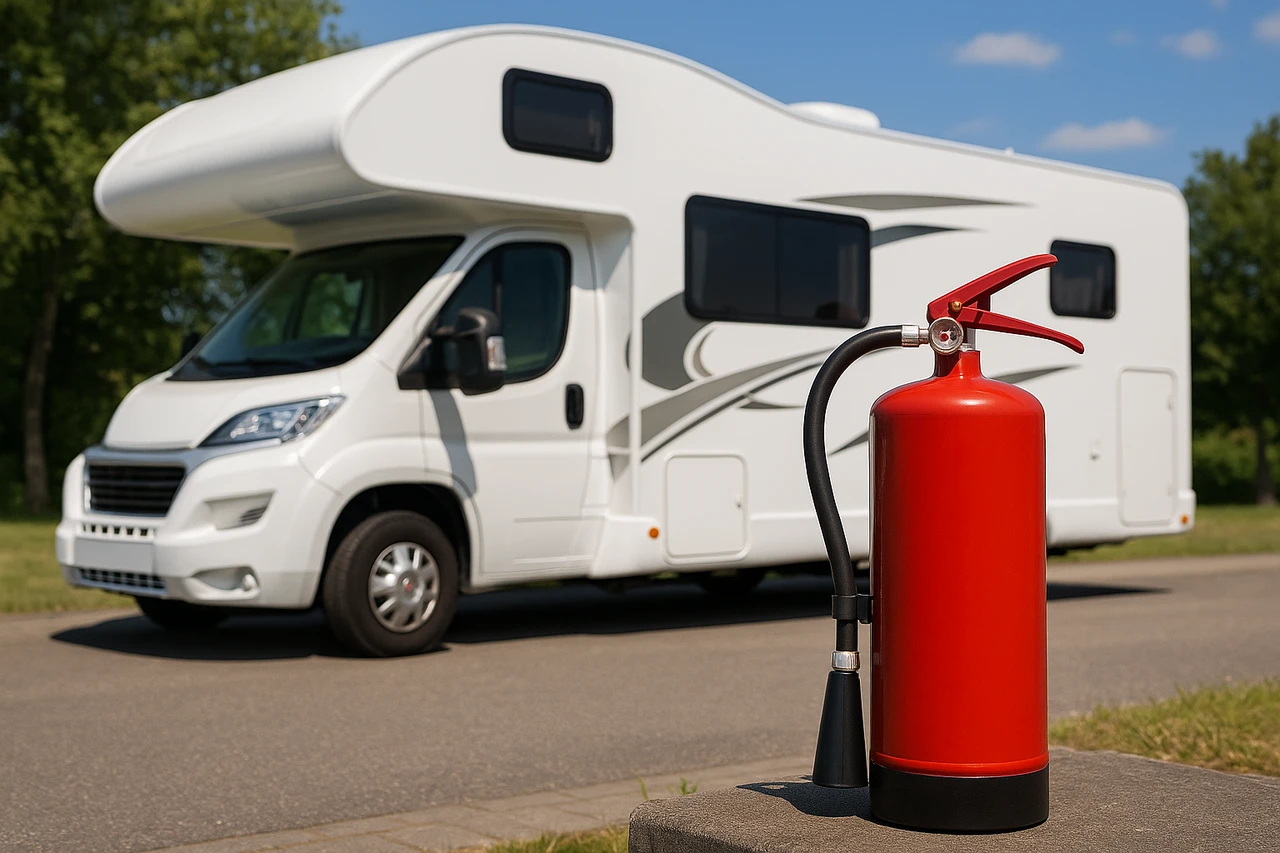
When you think of RV life, you probably picture winding highways, cozy nights under the stars, and coffee brewing in the morning mist.
What most RV owners don’t picture is a fire, a gas leak, or the silent danger of carbon monoxide.
Yet those are very real in every motorhome, in every trailer, and in every camper…and ignoring them can turn a dream trip into a disaster.
The good news is that with a few simple habits, you can travel with peace of mind.
Curious to learn more?
The Essential Safety Devices in Every RV
Every RV should be equipped with four key safety tools: a fire extinguisher, a smoke alarm, a carbon monoxide detector, and a propane gas detector.
Each serves a specific role, and together they form your first line of defense.
A fire extinguisher is designed to handle small and contained fires. RVs should be equipped with at least one ABC-rated extinguisher, which means it works well on wood and paper fires, flammable liquid fires, and electrical fires.
It’s important, however, to also understand that extinguishers have only a few seconds of spray. Their job is not to put out a major fire but to buy you precious seconds that you can use to escape or knock down a small flare-up before it spreads.
A smoke alarm provides early warning of fire, and often before you see or smell smoke. In a small space like an RV, fire can spread very quickly, so those extra seconds are super critical.
A carbon monoxide (CO) detector, meanwhile, monitors for the odorless and invisible gas that is produced by things such as generators, propane appliances, furnaces, and engine exhaust. CO can be fatal even in small amounts, and because it cannot be seen or smelled, a detector is the only reliable safeguard.
A propane detector (which is also sometimes part of a combined CO/LP unit) will alert you if propane gas is leaking into the cabin. Propane is heavier than air and will sink to the floor, so leaks may go unnoticed until it’s too late.
Legal Requirements for RV Fire and Gas Safety
Most new RVs are sold with smoke alarms and CO detectors already installed, but laws and requirements vary by state/province and by country.
In many places, carbon monoxide detectors are legally required in any dwelling (including in motorhomes and trailers) that contains a fuel-burning appliance or an attached garage.
Trailer owners may assume that they are exempt, but if a trailer has propane systems, CO and propane alarms are still required.
Smoke alarms are also a legal requirement in nearly all jurisdictions.
The National Fire Protection Association (NFPA 1192) requires that RVs be equipped with at least one fire extinguisher, a smoke alarm, and a carbon monoxide detector. Many states adopt these standards as law. Some provinces in Canada mandate propane detectors too.
How Often to Inspect and Replace Safety Devices
Fire extinguishers should be checked monthly, without exception.
To do this, pick it up and make sure that the pressure gauge is in the green, that the safety pin is secure, and that there are no dents or corrosion. Then shake or tap it to loosen the powder inside, because vibration from travel can compact the agent at the bottom.
You will also need to replace extinguishers immediately if the gauge shows low pressure, if they are damaged, or if they are older than 12 years without professional servicing.
Smoke alarms, CO detectors, and propane detectors should be tested weekly when you are using the RV. Just press the test button and listen for the alarm. The batteries should be replaced at least twice a year, and even if the unit still chirps normally.
Detectors themselves have expiration dates, which is typically every 7 to 10 years for smoke alarms and 5 to 7 years for CO and propane detectors. Always replace the entire unit at the end of its lifespan (even if it still seems to work, just so you can be on the safe side).
RV Age, Size, and Class Considerations
A large Class A motorhome needs more safety devices than a small Class B camper van. That’s why NFPA recommends at least one smoke alarm in every sleeping area and one in the main living area.
Class A RVs with multiple rooms should have multiple alarms, while smaller Class B and Class C RVs may only need one in the main cabin and one near the bed.
Carbon monoxide detectors should be installed in or near every sleeping area. Since CO is lighter than air, the detectors should be placed high on a wall or on the ceiling. Propane detectors should always be installed close to the floor (and ideally within six inches) since propane sinks.
Trailers present their own challenges. Many travel trailers and fifth wheels are decades old, and their original safety devices may be outdated or nonfunctional. If your trailer is more than ten years old, you can check whether the alarms have ever been replaced and then you can assume that they need to be upgraded if you are unsure.
Common Mistakes RV Owners Make
Too many RV owners assume that the safety equipment that came with the rig is enough forever.
In reality, however, detectors expire, extinguishers lose pressure, and batteries fail. Some owners remove chirping alarms instead of replacing batteries, which leaves the RV unprotected.
Others mount their propane detectors too high to a position where they cannot detect leaks at floor level. A common mistake is storing the fire extinguisher in a cabinet with the door closed.
Plain and simple, extinguishers should always be mounted in plain sight and ideally near the door so that they can be grabbed instantly in an emergency.
Building a Practical Maintenance Routine
The best way to keep on top of safety is to make it part of your regular RV routine. Add the following to your checklist:
- Test all alarms once a week while traveling
- Replace batteries in every detector every spring and fall when the seasons change
- Inspect your fire extinguisher every month
- Replace detectors at the manufacturer’s end-of-life date
- Run a fire drill with your family or travel companions at the start of each trip
- Practice escaping through two exits and designate a meeting point outside the RV
Connecting Safety to Real-World Scenarios
Imagine cooking dinner on your propane stove when a sudden flare sends flames up the backsplash.
A working extinguisher within arm’s reach can knock it down before it spreads. Or picture a family who’s asleep in a Class C and totally unaware that the furnace exhaust is leaking CO back inside.
When the CO alarm sounds, the family can quickly evacuate and lives are saved. But without those devices maintained and tested…those scenarios could end very, very differently.
How Leisure Coachworks Helps You Stay Safe
At Leisure Coachworks, we know RV safety is more than a box to check. We stock RV-rated fire extinguishers, smoke alarms, carbon monoxide detectors, and propane detectors.
These units are built for the unique vibration, humidity, and movement of RVs, not just household use. Our service team can install and test them, and we can add extra alarms for large rigs or retrofit older trailers that never had detectors to begin with.
If you are unsure whether your detectors are still in working order, bring your rig in and we’ll get to work where we test and replace and show you how to care for them. Our technicians can also check your propane system for leaks and will also make sure that your exhaust systems are venting properly.
Fire, smoke, carbon monoxide, and propane risks exist in every RV, and it frankly doesn’t matter if it’s a sprawling Class A motorhome or a compact travel trailer.
The difference between a minor scare and a major tragedy often comes down to the simple question: were your alarms working and was your extinguisher at the ready?
But with consistent checks and timely replacements, you can travel safely knowing your rig is protected.
And when you need replacement parts, professional inspections, or expert installation, Leisure Coachworks is your trusted partner. Feel free to pay our website a visit for alarms and extinguishers, or alternatively you can schedule service with as well.
Remember, just a little preparation now is what will ensure that you spend your time actually enjoying the open road…and not dealing with emergencies that could have been prevented in the first place.